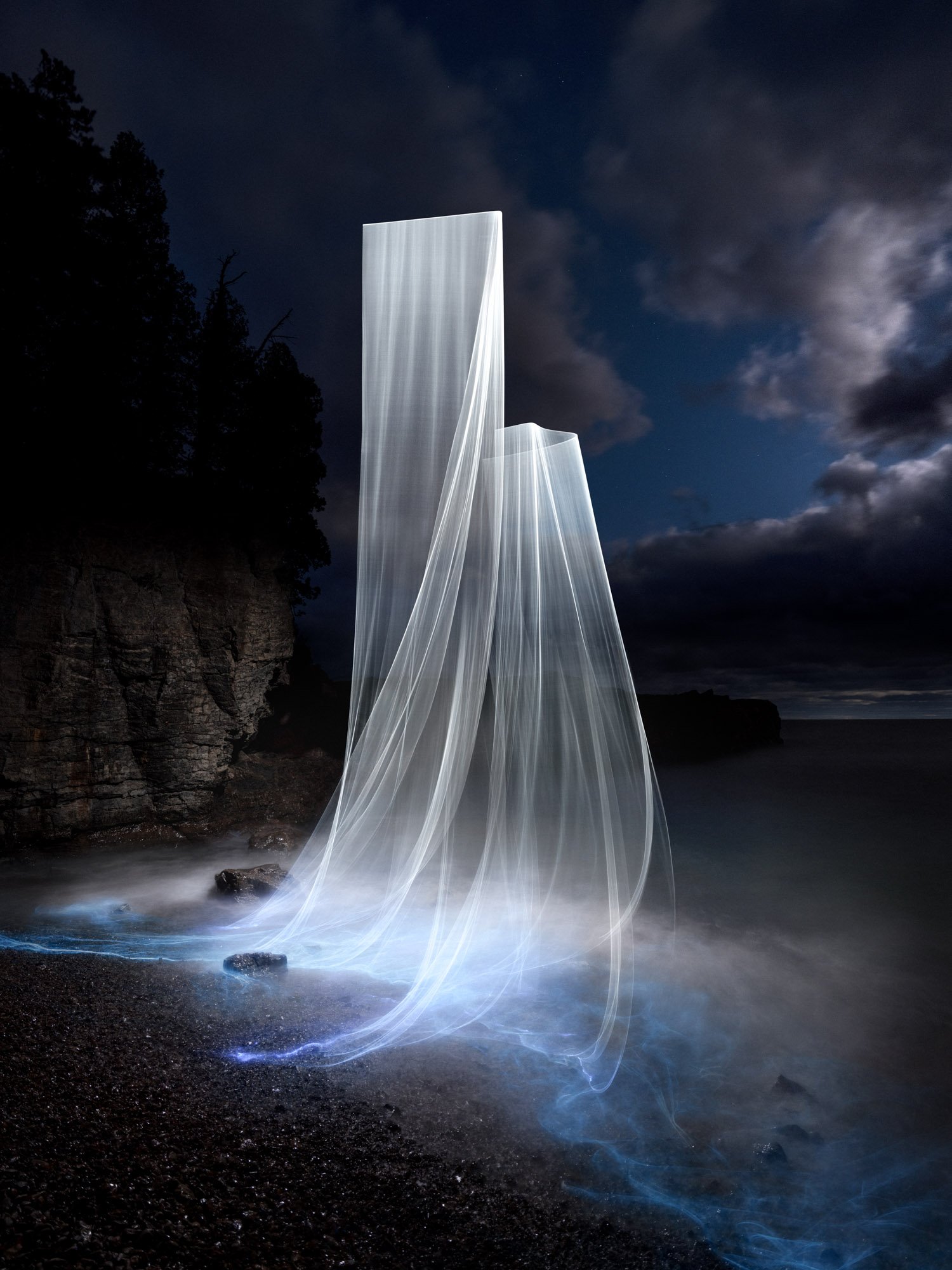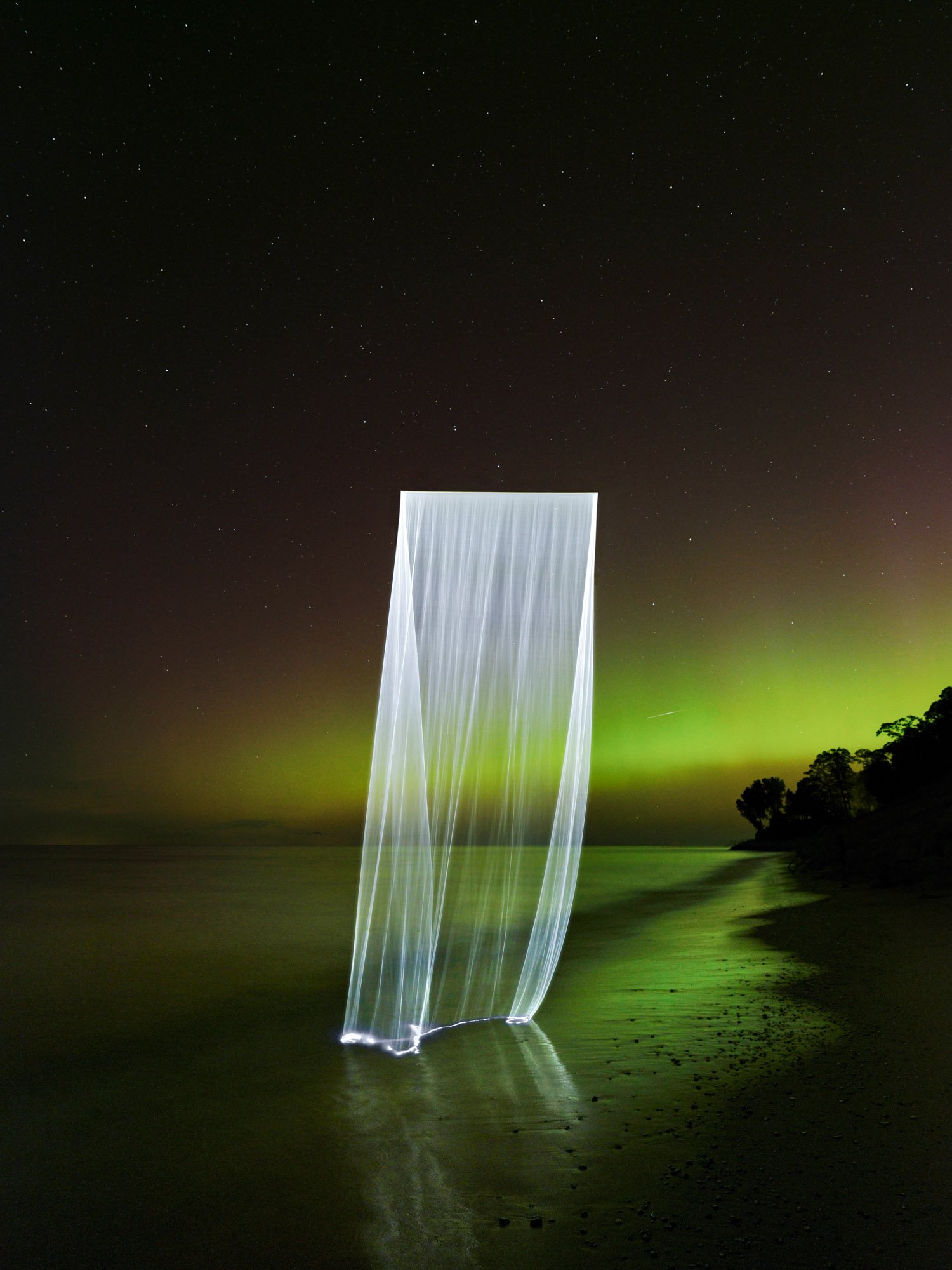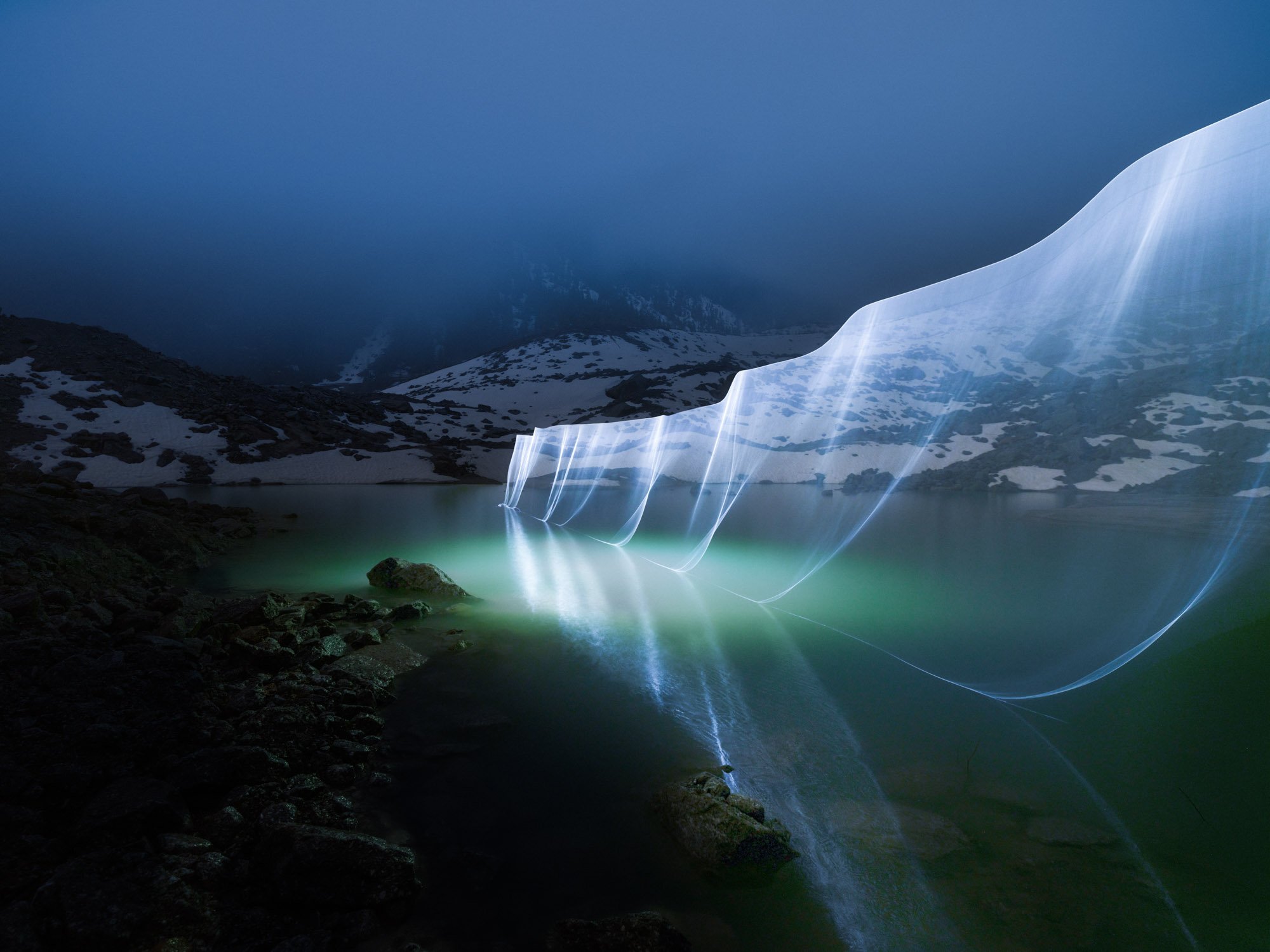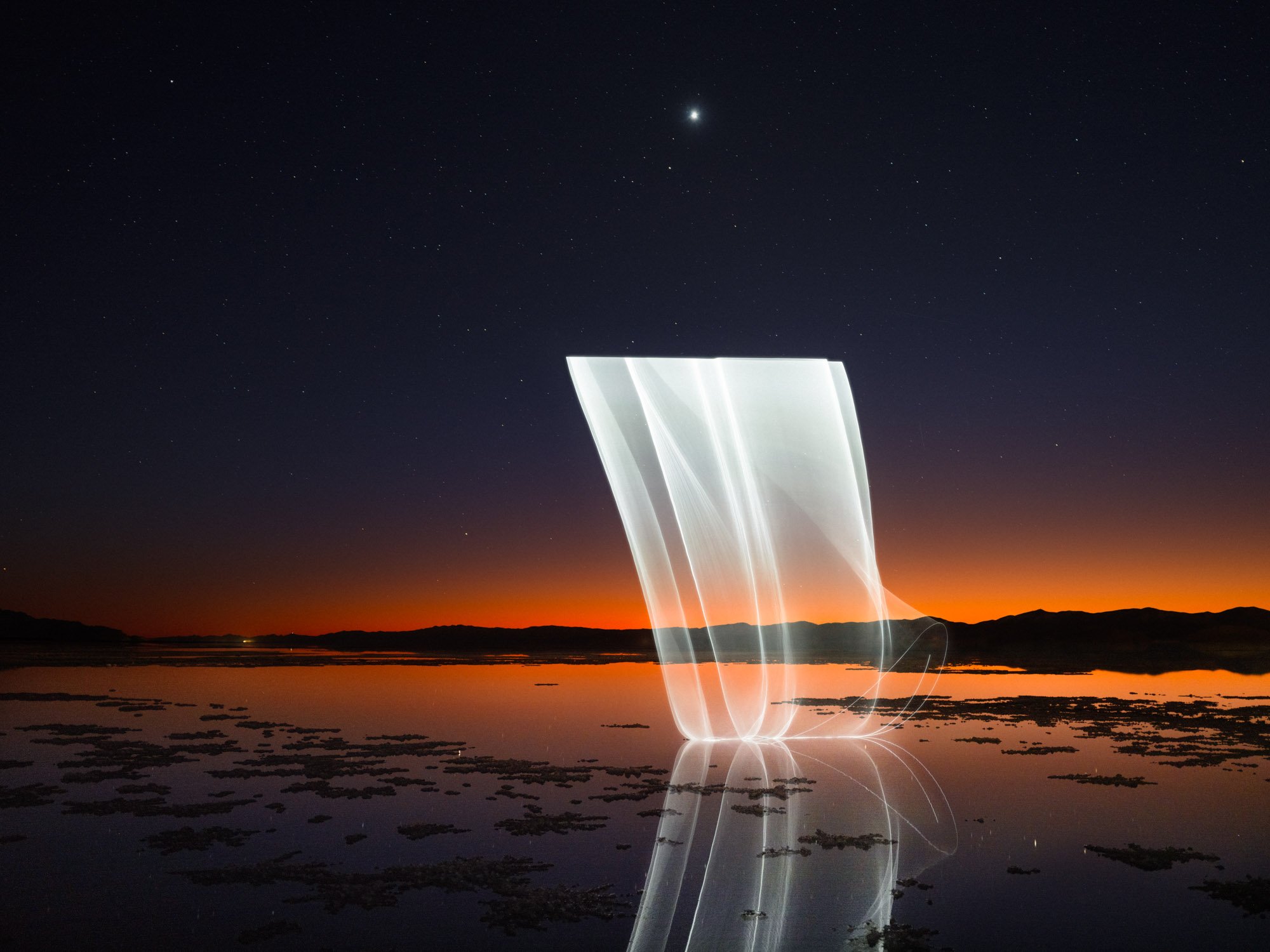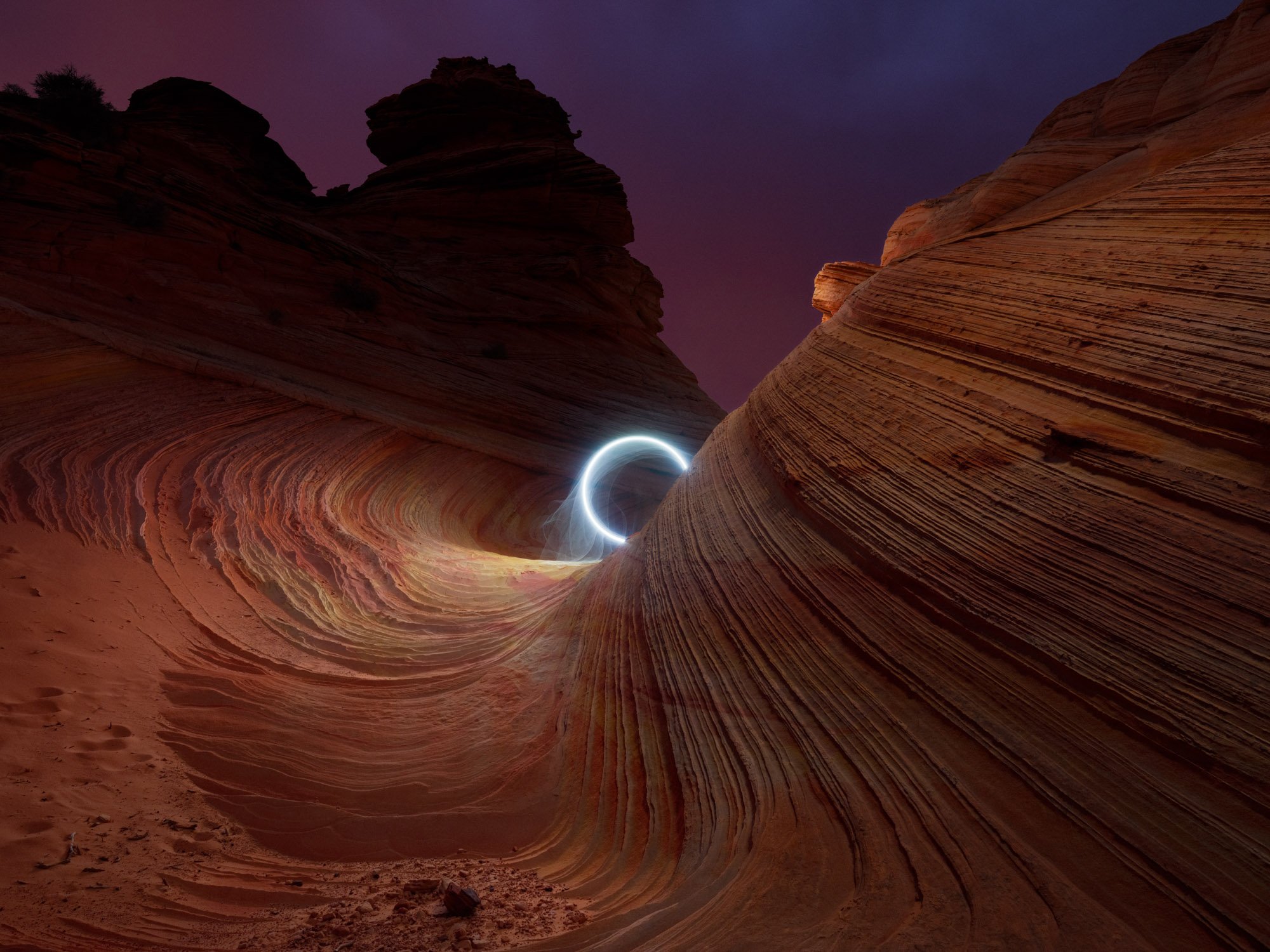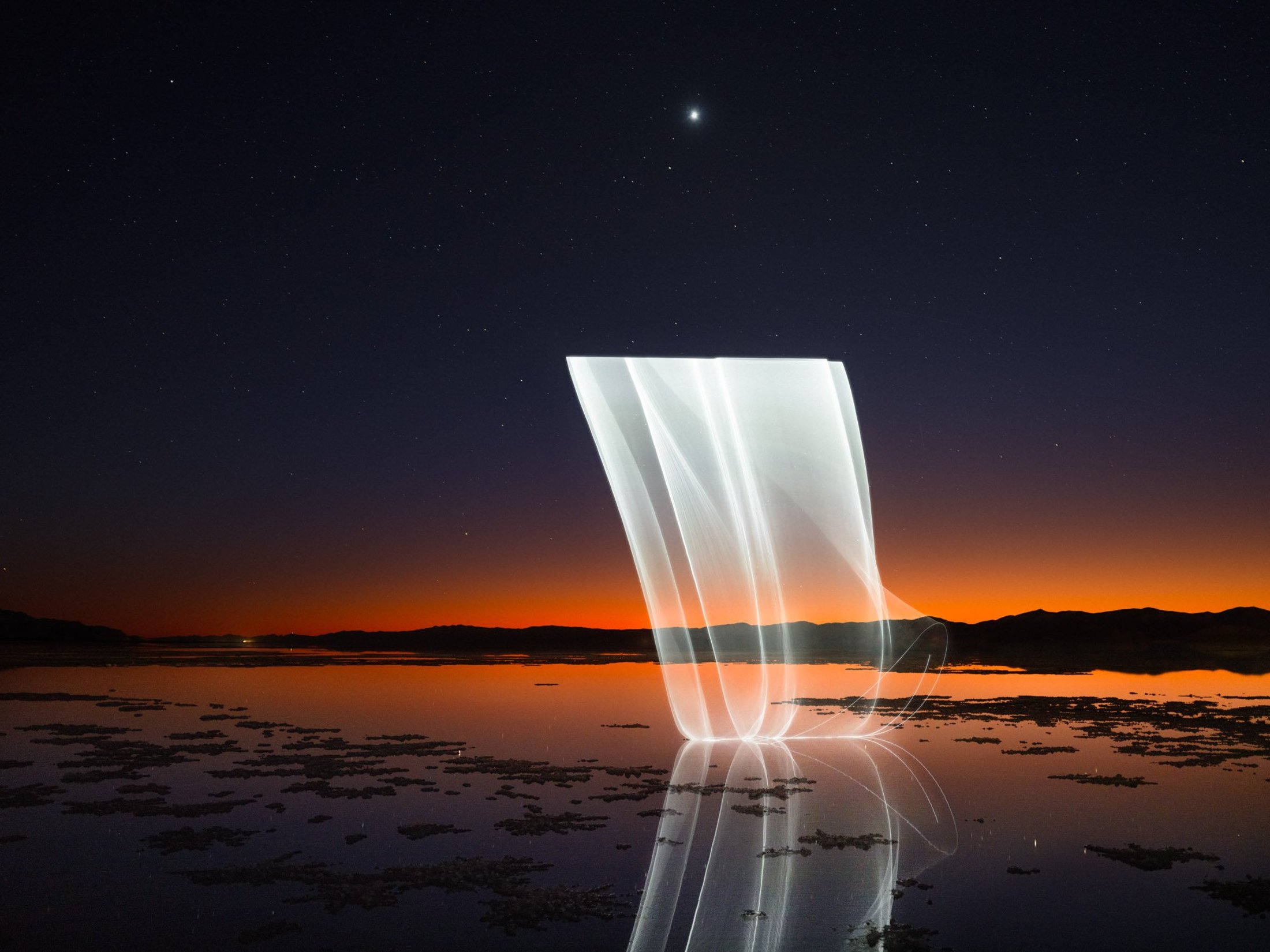
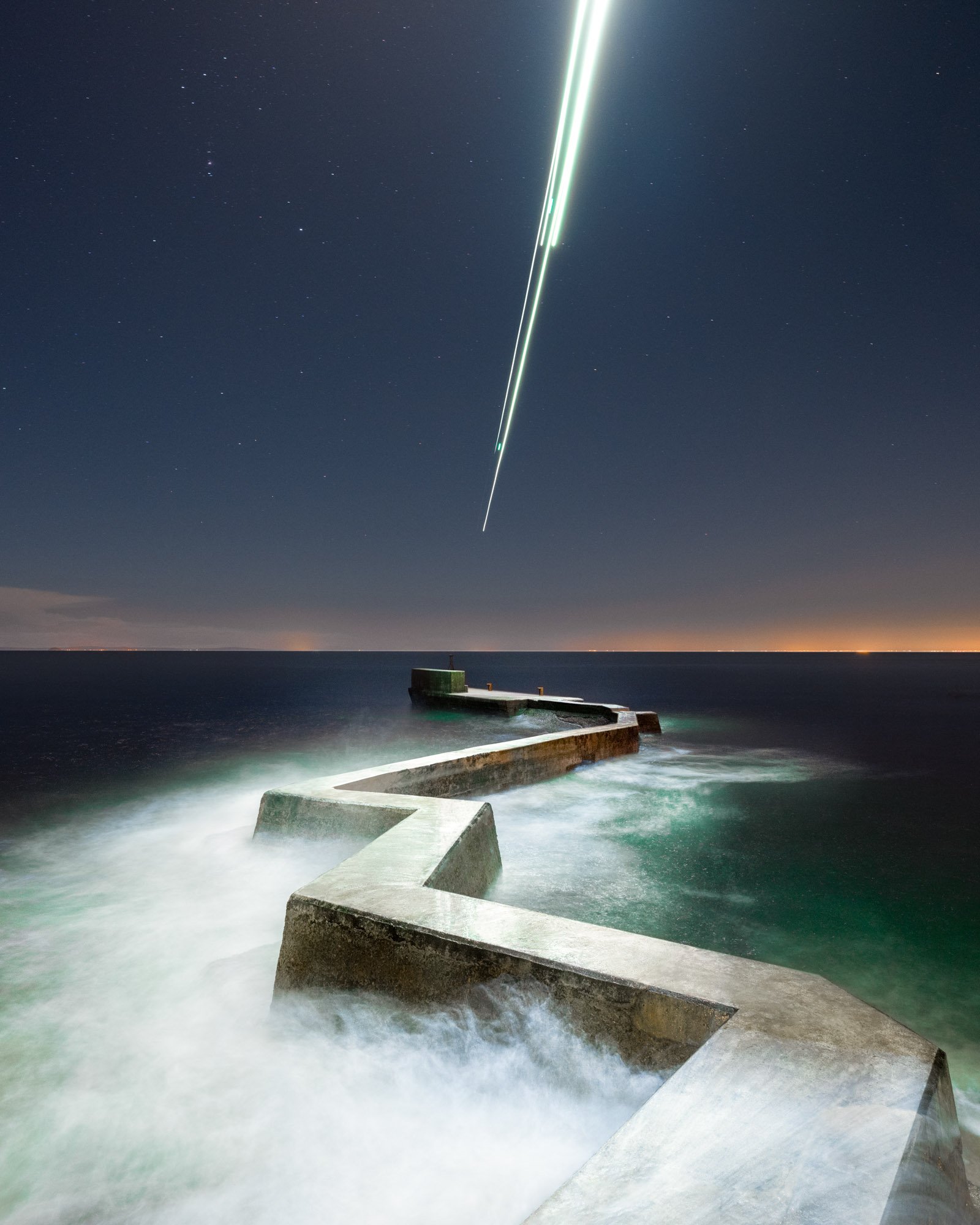
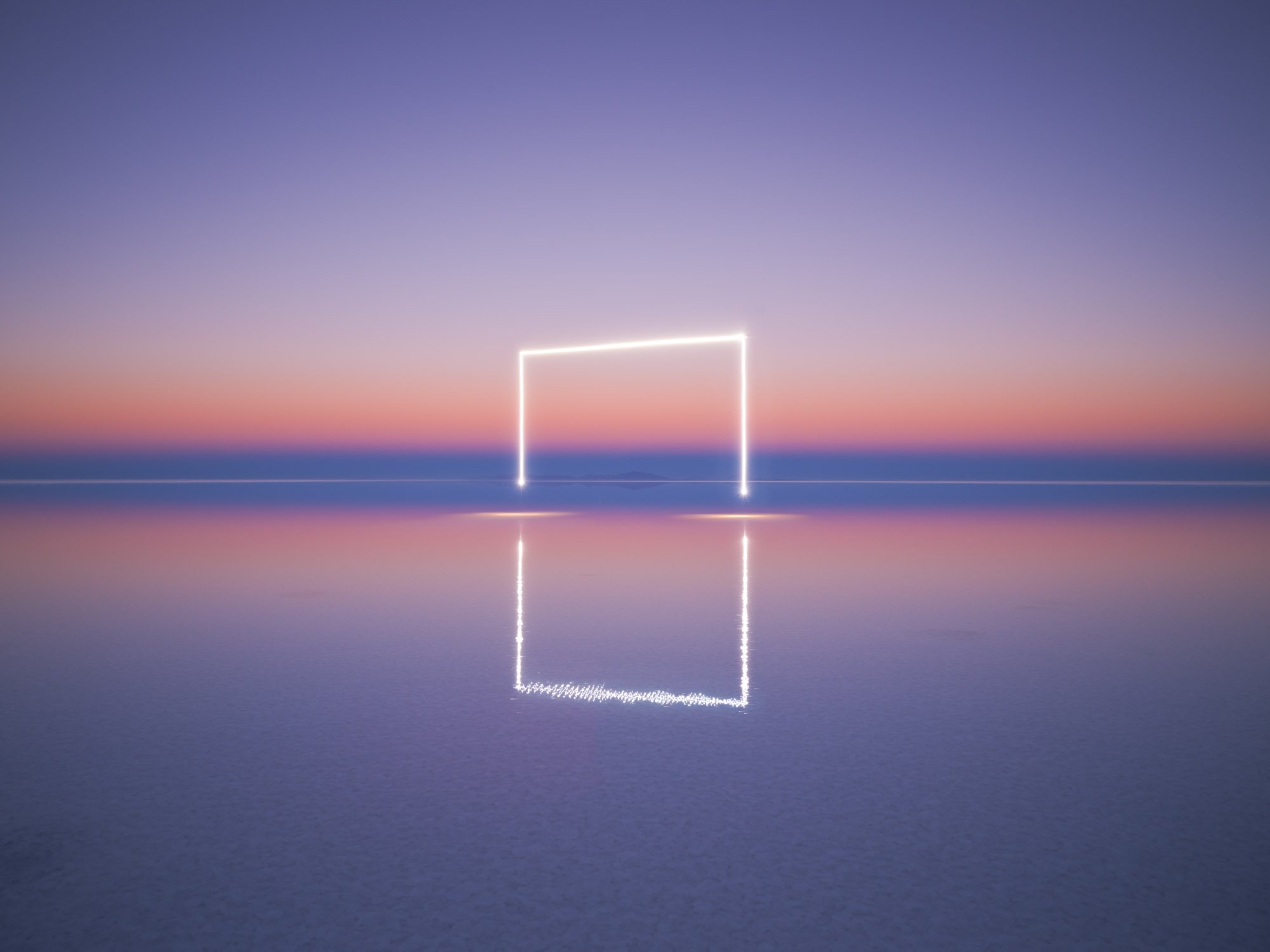
In Reuben Wu’s uncanny photographs, bright light becomes a pliable material—a character dancing through landscape. Sometimes it appears as a thick yet ghostly sheet, caressing water. Sometimes it bends into perfect circular forms. At others, it breaks into lines marking the sky. Over time, Wu’s approach to playing with artificial light in remote environments, a technique he has named ‘Aeroglyphs,’ has shifted from control to surrender.
Though devoid of any human presence, each image is the outcome of the photographer’s committed process—of time spent outdoors, sometimes in the dead of night, waiting, watching and adjusting his technique. His latest project Siren, made during a trip to Lake Michigan last year, embraces a new sense of fluidity. Shot under the rare meeting of the Perseid meteor shower and the aurora borealis, Wu’s light forms shimmer and shake unpredictably in dialogue with this rare summer event and its effects on the landscape.
In this interview with LensCulture, he speaks to Sophie Wright about life on the road, the origins of the Aeroglyph and the importance of presence in his photographic practice.
Sophie Wright: Your route to photography has not been linear, starting in Liverpool, UK and taking you all the way to your adopted home of Chicago, with stop off points at design and music and many other fascinating locations. Can you walk me briefly through your journey?
Reuben Wu: I was born in Liverpool to parents who immigrated from Hong Kong. As a child, I loved drawing and wanted to grow up to be an artist, but my mother wisely encouraged me toward a more stable path. So I studied industrial design, though my real passion at the time was music, DJing and collecting records in Sheffield’s vibrant music scene. After graduating, I formed Ladytron with friends in Liverpool. Our first single immediately earned ‘Single of the Week’ in NME, and suddenly I was leaving my design job for a decade of touring the world.
Photography began as a tour diary, but gradually became an obsession. In 2011, I took my first dedicated photography trip to Svalbard, creating my first cohesive body of work. When the band took a break, I faced reinvention again, this time committing fully to photography. I moved to the USA in 2013, settling in Chicago. The breakthrough came in 2015 when I started using drone-mounted lights to illuminate landscapes, creating what would become a signature approach of mine.
Looking back, where I am now is only possible because of those detours. My design background gives me technical and compositional understanding, the music taught me about mood and rhythm, the years of travel opened my eyes to the world’s landscapes. Everything feeds into what I do now. Each seemingly separate path was actually preparing me for my current practice which now feels like more than just photography.
SW: Looking through the evolution of your projects, there seems to be a strong relationship between movement and photography, transience, preservation and attention. Would you say your travels have informed how you approach making pictures in any way?
RW: Absolutely. Those years of constant movement with Ladytron taught me to find beauty in transience, to capture moments that would never repeat. Everything around me was temporary: venues, cities, faces, but the camera (and myself) remained constant. That experience shaped how I think about my landscape work now. The light interventions I create are equally ephemeral, existing for mere minutes during creation, leaving no permanent mark. There’s something powerful about preserving these fleeting moments in my memory, whether it’s a particular quality of light or a geometric form that seems to appear in darkness before disappearing.
SW: The ‘Aeroglyph’ is a foundational concept in your visual language that seems to shape how and what you photograph—and perhaps most interestingly from which perspective. Tell me about the breakthrough that led to this technique, what drew you to continue developing it and the name you found to describe it.
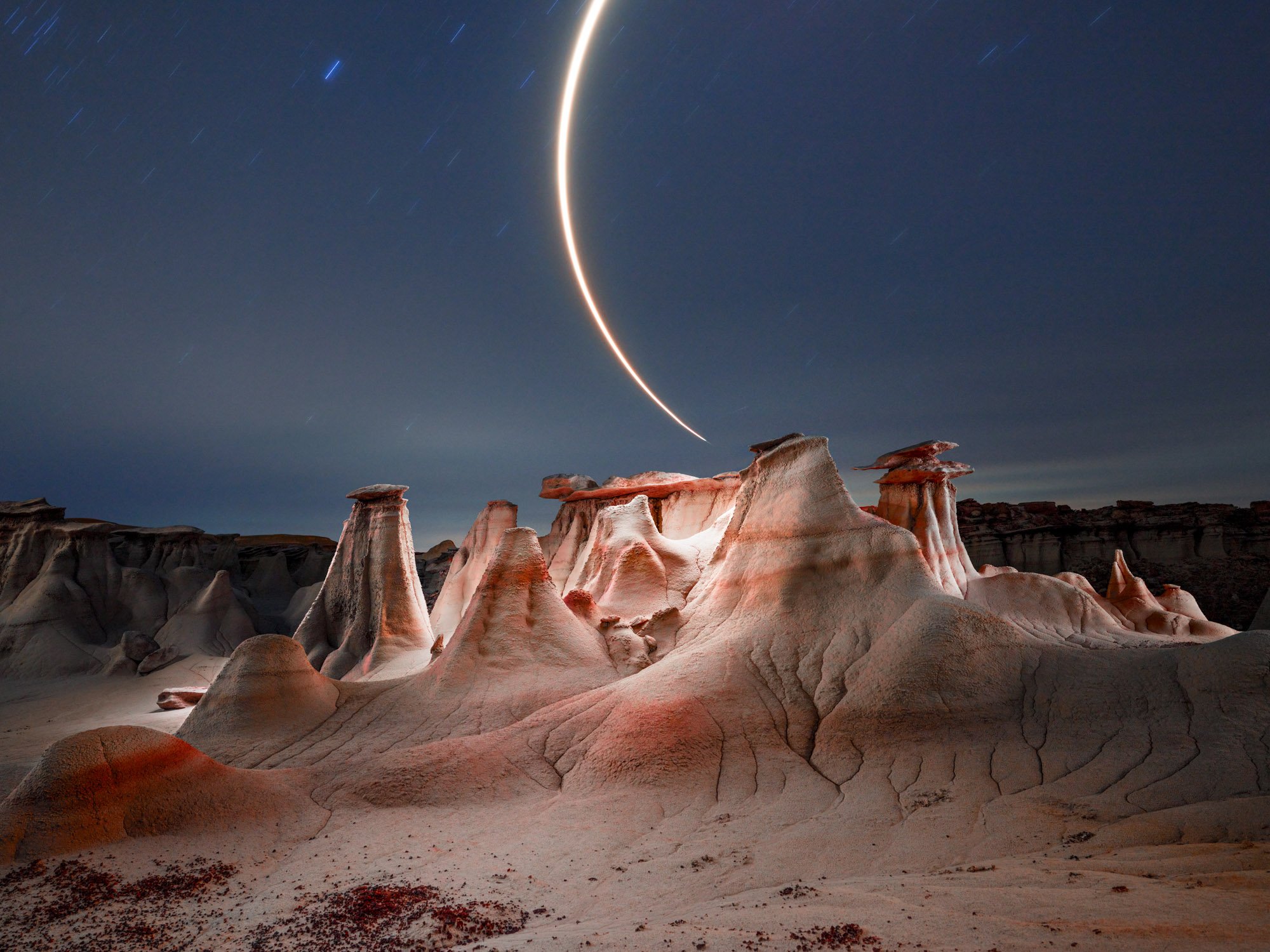
RW: The seed was planted in 2014 at the Trona Pinnacles national monument in California when a truck’s headlights accidentally illuminated the landscape during a night shoot. Instead of ruining the image, it created this effect that shouldn’t naturally exist. That sparked the idea of using artificial light in remote environments. In 2015, I started attaching lights to drones, bringing remote aerial lighting control into vast outdoor spaces.
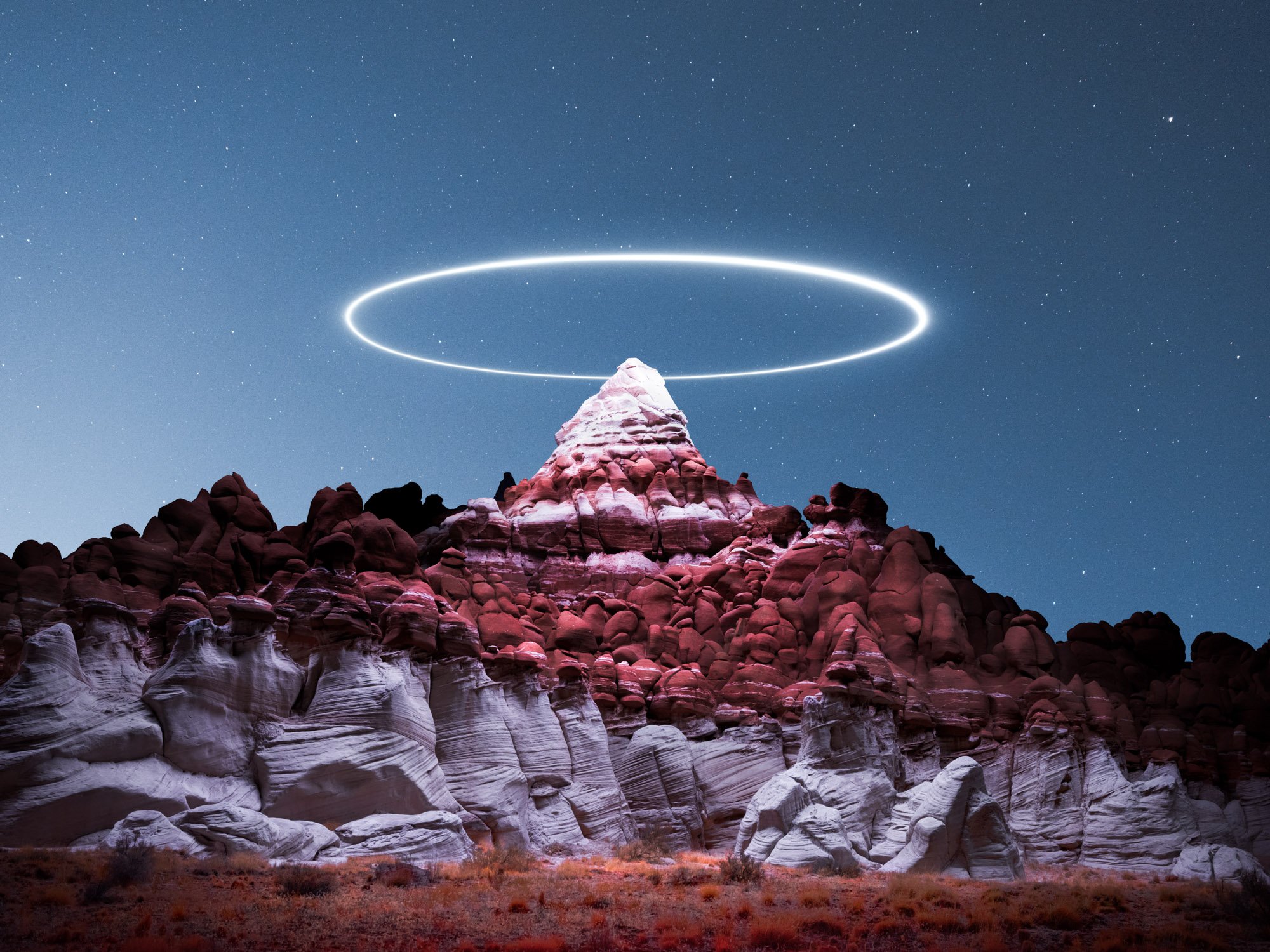
The next discovery came when I realized the drone’s flight paths themselves could become visible through long exposures. I could see these luminous geometric patterns forming above the landscape: circles, lines, polygons suspended in darkness. They felt like a form of land art, but without physically touching the earth. I named them Aeroglyphs—literally “drawings in the air.” The name captured both the aerial perspective and the graphic quality of these light forms. What drew me to continue was the tension they created; precise geometric shapes imposed upon organic, chaotic landscapes.
SW: How has the Aeroglyph evolved over time?
RW: My early Aeroglyphs emphasized geometric precision; perfect circles, straight lines, controlled patterns. Over time, my relationship with control has shifted. Projects like Siren explore something more fluid and organic, where the light responds to environmental forces rather than imposing rigid patterns. The forms have become less architectural and more elemental, suggesting something both intentional and alive. If the earlier aeroglyphs manifested themselves through control, the aeroglyphs in Siren are the result of surrender.
SW: From the barren landscapes of the North Pole to power plants in Nevada via documenting cosmic mechanics in the Chilean mountains, your work is intertwined with place with the sky as an anchor point. What draws you to the landscapes you choose to photograph?
RW: I’m drawn to places that feel like they exist between worlds—remote locations where the boundary between familiar and otherworldly feels thin. Growing up, I was obsessed with the landscapes in National Geographic that seemed impossibly sublime. Now I seek out these places myself, but with a specific focus: showing that these seemingly alien landscapes aren’t from distant planets: they are right here on Earth.
I look for locations that already have a kind of tension or mystery built in, whether it’s the vast stillness of the Arctic, the glow of industry in the desert, or the precision of architecture built into a mountaintop. The sky becomes a constant reference point, a reminder that everything we build or observe here is part of a much larger system.
It’s about presence—acknowledging a place rather than describing it. There’s a difference between taking a photo and leaving versus truly knowing a place by spending hours there in the darkness. When I’m working through a long night shoot, something shifts. Part of my mind stays in that location even after I leave. I’m engineering my own memories, creating these deep connections with places through the time invested in them. The photographs become artifacts of that relationship, not just visual records. Standing alone at 3am in these environments, you experience something that can’t be rushed or faked. That presence—that commitment to really being there—becomes embedded in the work itself.
SW: Tell me about the origins of your latest project Siren. Would you say it grows out of previous projects or does it represent a step in a different direction?
RW: Siren evolved directly from my Aeroglyphs work, but it represents a significant shift in approach. The concept began as a sketch back in 2021, exploring how I could move beyond geometric precision toward something more fluid and three-dimensional. While earlier Aeroglyphs imposed patterns on landscapes, Siren allows the environment to shape the light itself.
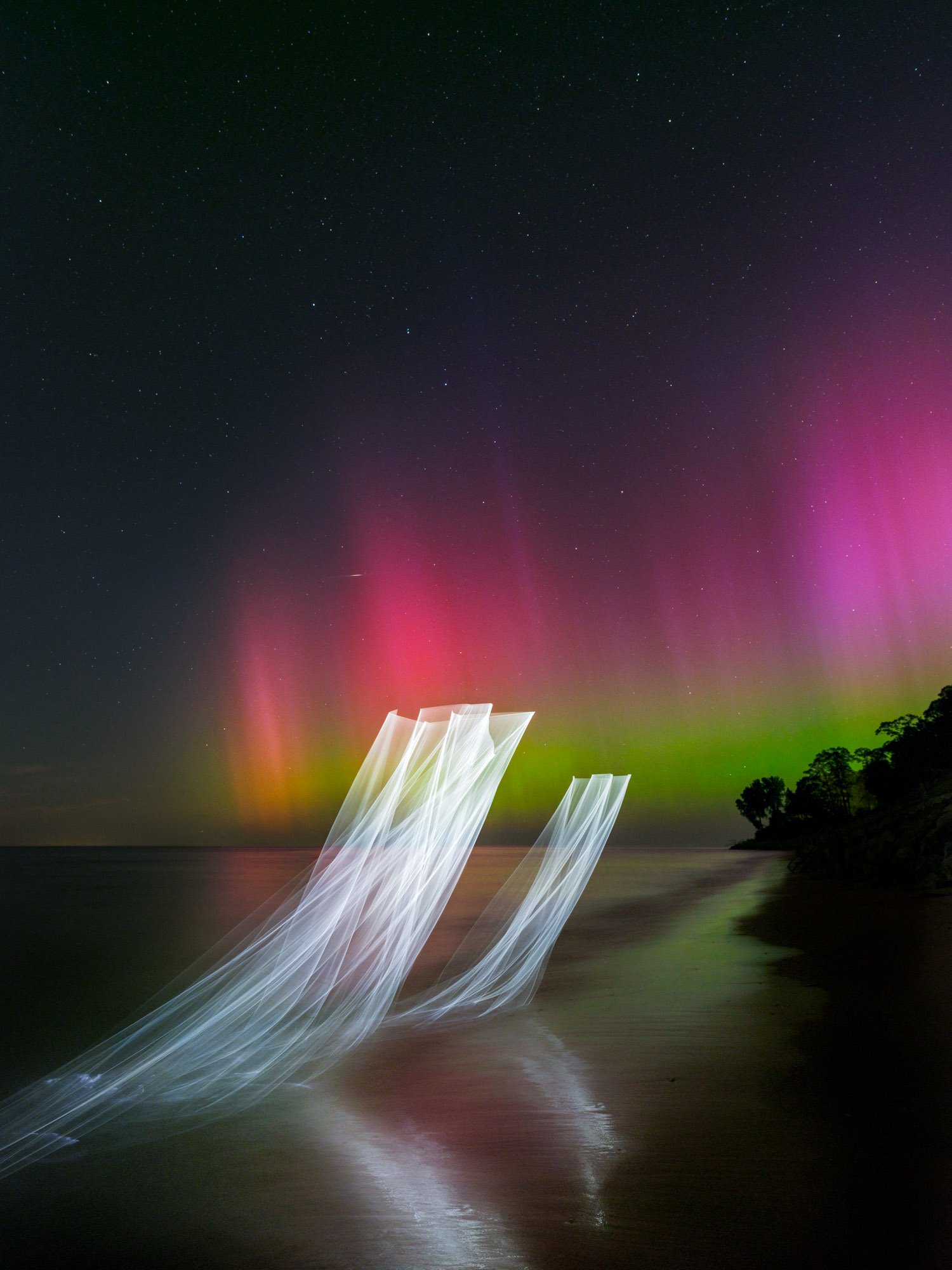
The breakthrough came during a family trip to Lake Michigan in August 2024. I was testing a new laser technique during the Perseid meteor shower when the aurora borealis made a surprise appearance—a rare summer event. The movement of waves on the shore was actually modulating the laser light source, creating these flowing, curtain-like structures. It was one of those moments where preparation meets serendipity. The series captures this new direction: light forms that breathe with the landscape rather than controlling it.
SW: As we’re dealing with a medium currently undergoing some pretty tectonic shifts in relation to AI, it is important to state these images are made using physical interventions. Can you elaborate on your work process for Siren?
RW: The process for Siren is entirely physical and happens in real time. I mount lasers to drones and fly them through the darkness above Lake Michigan’s shore. The waves washing up on the beach actually interact with the physical laser light, their movement creating spatial variations that I capture through long exposures. Each image is an interpretation of real physical dynamics of the location at that moment
I’m as much in love with making the photos as the final result—the physical presence in these environments, the technical challenges, the unpredictability of natural forces. AI is an awesome tool, but it can’t create the experience of standing on a beach at night, marveling at the aurora, watching these forms emerge through the interaction of technology and nature. These images exist because I was there—in that specific place, at that specific moment, having this dialogue between artificial and natural elements.
SW: You’ve mentioned Bernd and Hilla Becher—the parents of typological photography—and early spirit photography when talking about the project. Can you tell me more about the work that inspires you?
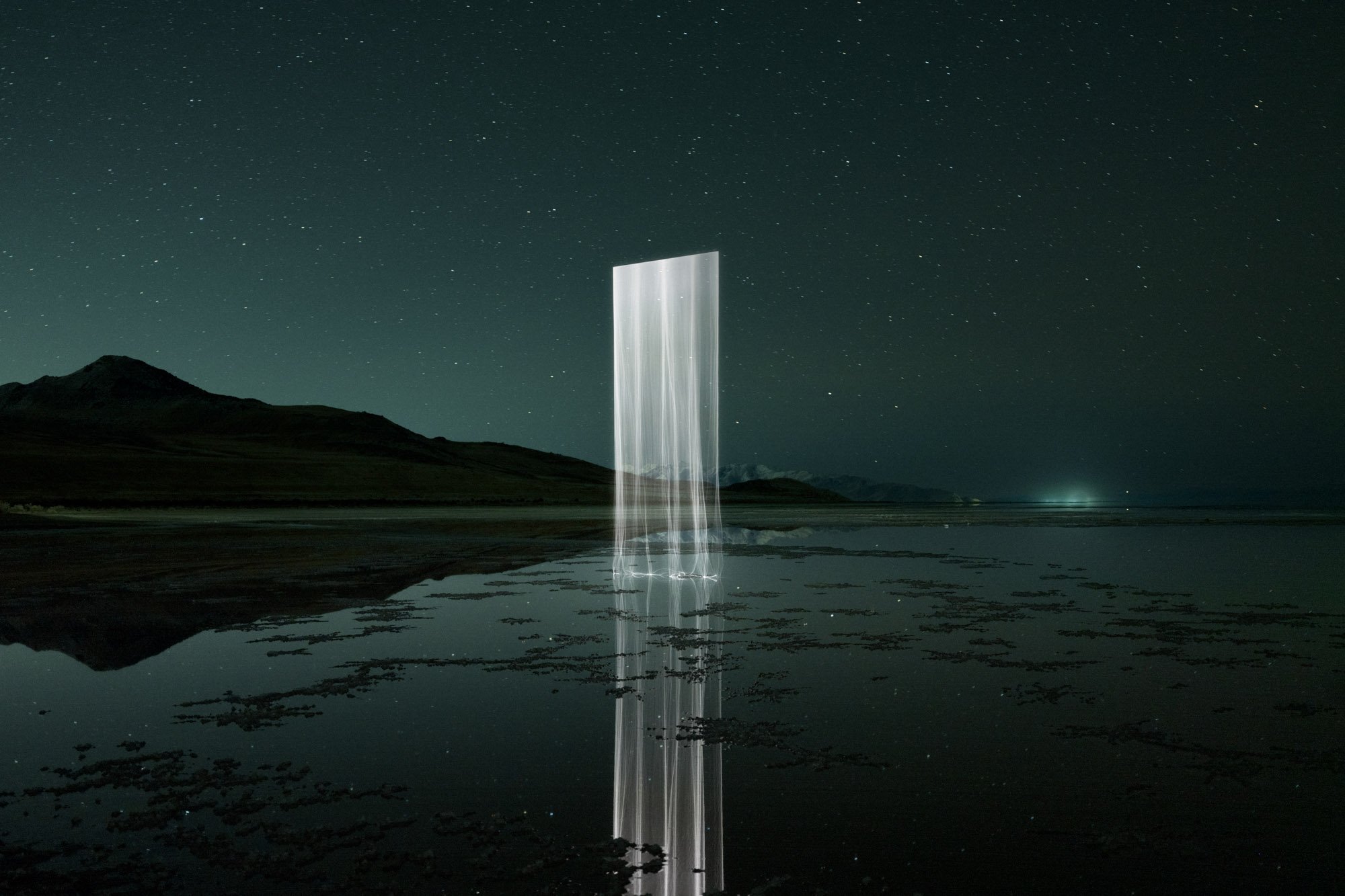
RW: The Bechers created systematic studies of industrial structures, photographing them in consistent conditions to reveal subtle variations. Siren follows a similar methodical approach—six forms captured at a single location, each responding differently to environmental conditions. But where the Bechers documented physical objects, I’m documenting ephemeral light phenomena.
The spirit photography connection relates to the mysterious, almost supernatural quality these forms possess. Early spirit photographs claimed to capture otherworldly presences, and while I’m not claiming anything supernatural happened, there’s something genuinely uncanny about these curtain-like structures hovering in darkness. They exist in a dimension of time visible only through long exposure, creating images that feel both documented and impossible.
Caspar David Friedrich’s paintings were hugely influential on me overall, particularly Wanderer above the Sea of Fog. The lone figure contemplating vast landscapes, that sense of sublime mystery—it resonated deeply with themes I explore in my own work. The 19th-century Romantic painters understood how to convey both the grandeur of nature and the human emotional response to it. From cinema, Close Encounters of the Third Kind had a massive impact on me as a child. Not the space battles of Star Wars, but the eerie searchlight hovering in the night sky, these seemingly impossible lights moving through ordinary landscapes. I call that “the threat of possibility.”
That image cemented itself in my brain and directly influences the work I do now. It’s always been about finding the extraordinary within the familiar, whether through Romantic painting’s approach to nature or science fiction’s way of making the mundane mysterious.
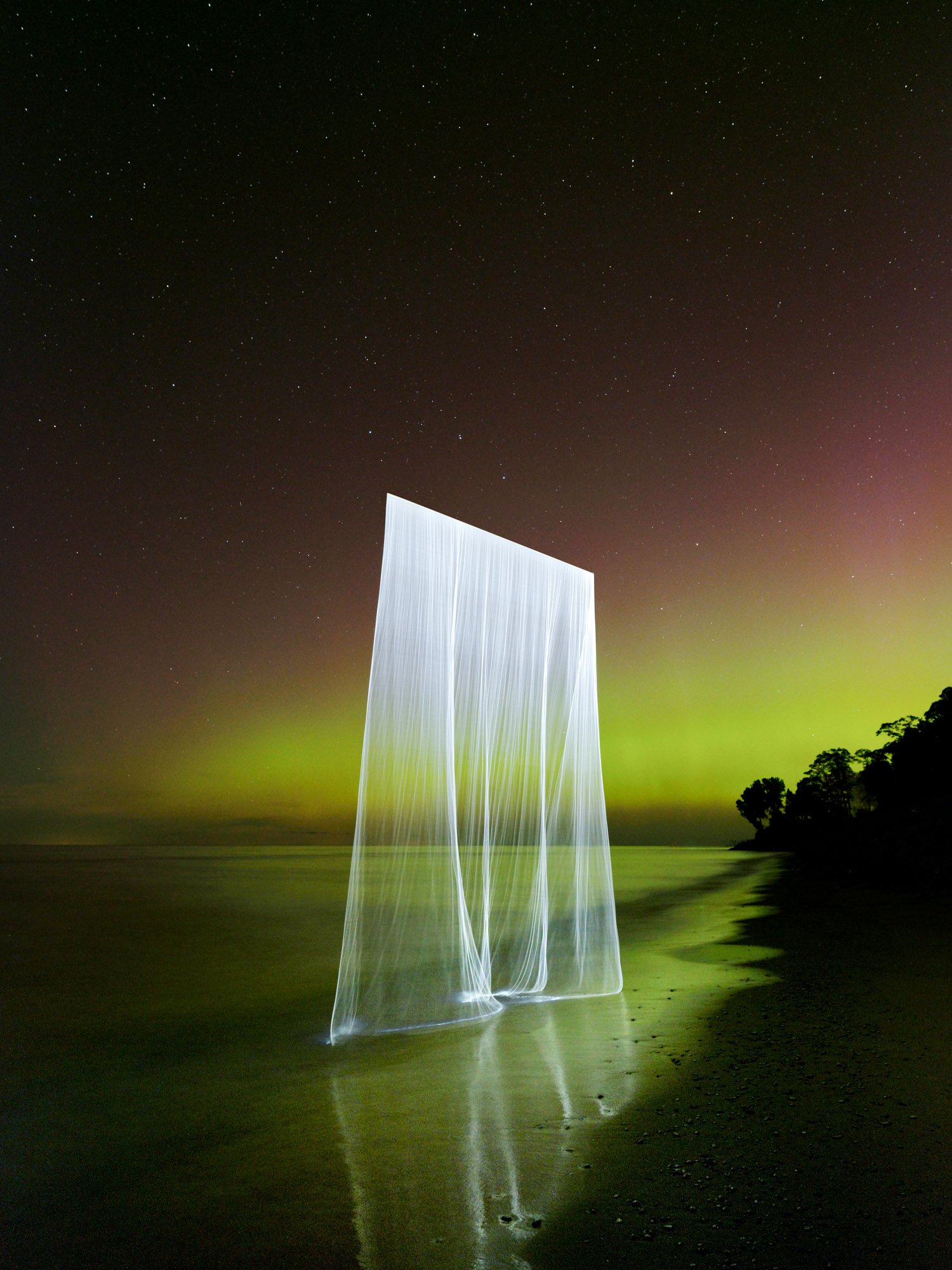
SW: The sky we see in the images is animated by the rare meeting of a Perseid meteor shower and the aurora borealis. How long did this phenomena last? Did you face any specific challenges on this shoot?
RW: The aurora’s appearance was completely unexpected and lasted perhaps an hour at most. It is extremely rare to see aurora borealis at this latitude during summer. The challenge was working quickly and instinctively to capture both the natural celestial event and my planned laser interventions simultaneously. The technical demands were intense, but I end up relying on intuition and instinct in these situations, my mind entering a kind of flow state.
SW: The images you make are charged with a sense of awe and wonder—and the adventure of photographing things that are difficult to capture. How important is it for you that your audience know the process behind them?
RW: There’s a balance to strike. I want viewers to experience that sense of wonder first, to question what they’re seeing before understanding how it was made. The mystery is part of the work’s power. But I also believe the physical process adds meaning—knowing these aren’t AI-generated or purely digital manipulations but real interventions in real places at specific moments in time.
The adventure and difficulty are integral to the work’s authenticity. When people learn I was at 17,000 feet in Peru or working through the night in sub-zero Arctic conditions, it adds another dimension to the images. These aren’t just beautiful pictures; they represent commitment, risk, and the willingness to push boundaries both technically and physically. That human element— the evidence of someone being there and creating these moments—is what separates this work from digital simulation. At the same time, I want the images to stand up on their own regardless of how difficult it was to make them. The art sells the art; the story seals the deal.
I’m currently showing work as large fine art prints in several exhibitions. Measures of Time is at Maven Gallery in Wichita, Kansas until November 15th, and VITAL: Our Irreplaceable Earth is on view at the Muscarelle Museum of Art in Williamsburg, Virginia. These exhibitions present the images at the scale they’re meant to be experienced—large enough that viewers can step into them, discover the subtle details and textures that reveal themselves only when you’re standing in front of the physical print. I’m also working on my forthcoming book AEROGLYPH, which will provide a comprehensive look at how this visual language has evolved over the years. Across different forms, the goal remains showing familiar places in unfamiliar ways—making people look twice at the world around them.